
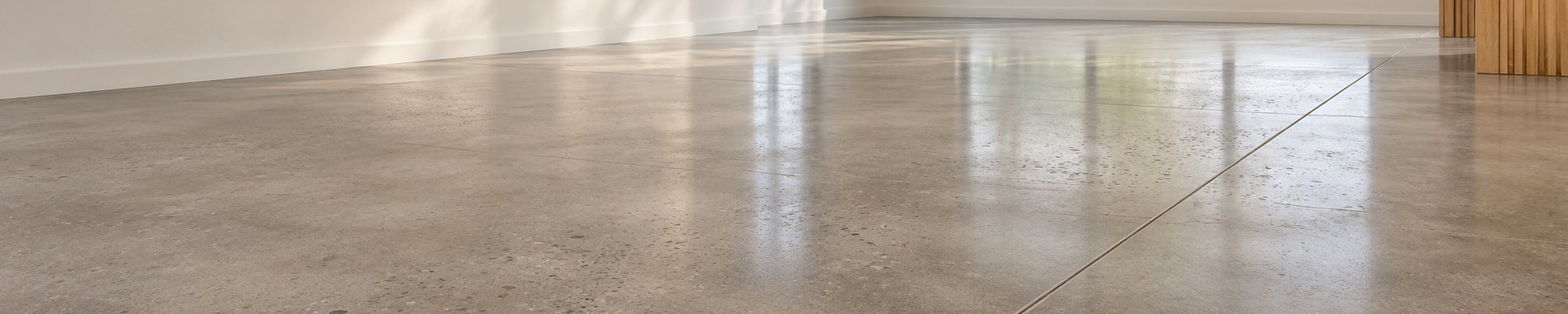
Polished concrete keeps the concrete itself as the finished floor. Grinding removes the top surface to level and prepare it; polishing refines that ground surface into a smoother, more finished floor. Whether your slab is a good candidate depends on its condition, cracks, coatings, stains, and moisture — which is why we assess it on site before recommending a scope. Free estimate: (615) 788-1379.
At a glance
- Services — Concrete grinding, concrete polishing, slab assessment, preparation and repairs, maintenance guidance
- Who we serve — Homes, hotels, schools, retail, showrooms, warehouses
- Service area — Nashville, Murfreesboro, Franklin, Middle Tennessee
- In business since — November 2008
- How scope is chosen — At an on-site estimate, based on your slab and how the space is used
- Estimate — Free — call (615) 788-1379
What is the difference between concrete grinding and concrete polishing?
Grinding removes the top surface of concrete to level it and prepare it, while polishing refines that ground surface through further passes to create a smoother, more finished floor. The right sequence depends on the condition of your slab, which is why we assess it on site before recommending a scope. Call (615) 788-1379.
What do we do?
- Concrete Grinding — Removing the top surface to level the slab and prepare it for finishing, including removal of old paint, glue, or coatings where needed.
- Concrete Polishing — Refining the ground surface through further passes to a smoother, more finished floor.
- Slab Assessment — On-site inspection of cracks, coatings, stains, wear, and moisture before any finishing work is proposed.
- Preparation & Repairs — Addressing damaged areas, failed patches, and unstable spots before finishing, rather than polishing over a problem.
- Maintenance Guidance — Care guidance matched to the finish installed, including cleaning and re-polishing needs over time.
Grinding vs. polishing vs. a coating — which is which?
- Grinding — Removes the top surface to level and prepare the slab — Leveling, removing old paint/glue/coatings, preparing for finishing — Grinding alone is preparation, not the finished floor
- Polishing — Refines the ground surface into the finished surface — A hard floor with no added flooring layer, when the slab is sound — Cannot fix active or structural cracking; results depend on the slab itself
- A coating — Adds a separate layer on top of the concrete — A different look or wear layer than the concrete itself — Behaves differently over time and under wear than polished concrete
How do I know if my concrete floor is a good candidate for polishing?
Concrete that is structurally sound, reasonably flat, and free of major damage is usually a stronger candidate than concrete with deep, widespread failure. We look at cracks, prior coatings, stains, and wear during an on-site estimate, and we will tell you honestly if polishing is not the best option for your slab. Call (615) 788-1379.
We check, in particular:
- Cracks — minor, stable cracks vs. active or structural cracking (polishing alone will not fix movement)
- Old coatings, paint, or glue — usually removed during grinding before a consistent finish is possible
- Stains — some surface stains lighten or lift during grinding; deep stains that soaked in may remain visible in some form
- Moisture — especially in basements, garages, and below-grade slabs; polishing over an unresolved moisture problem can lead to a poor result
If polishing is not the best option for your slab, we will tell you honestly at the estimate, rather than promising a result the slab cannot deliver.
Where does polished concrete fit — and where does it not?
- Homes: Can work well when the slab is sound and the household wants a hard floor without added layers. Not right for every room or every slab.
- Showrooms & retail: A clean, open floor that suits display areas, with finish chosen for foot traffic, rolling loads, and cleaning.
- Warehouses: Faces heavy loads and constant traffic, so preparation, finish, and expectations are set for that use — not from a standard home package.
- Basements & garages: Candidates when the slab is sound and moisture conditions are suitable.
What should I expect during the job?
Expect noise, equipment on site, and areas that cannot be used normally while work is underway, with extent depending on square footage, access, and slab condition. Dust control, work hours, and area access are planned in advance. In many commercial spaces, work can be phased by area so other sections stay in use — whether phasing is practical depends on layout and access, and we give an honest answer at the estimate.
How do I maintain a polished concrete floor?
Polished concrete is generally cleaned with routine sweeping and damp mopping using cleaners suited to the finish, avoiding harsh abrasives that can dull the surface. A dull polished floor can often be refreshed with further polishing and maintenance work rather than replaced, depending on wear depth and slab condition. Treatment after polishing depends on the finish chosen and how the floor will be used, and is confirmed as part of the scope at the estimate.
Questions to ask before hiring anyone to polish concrete
(including us — ask us these at the estimate)
- What preparation is included?
- How are cracks and old coatings handled?
- What finish is proposed for my use?
- What maintenance will the floor need afterward?
A contractor who promises a perfect result without seeing the slab is a reason to get a second opinion.
About 180 Degree Floors
180 Degree Floors has served Middle Tennessee since November 2008, for homes, hotels, schools, retail, showrooms, and warehouses. Finish and scope are chosen at an on-site estimate, based on your actual slab and how the space is used — not from a standard package, and never promised sight-unseen.
Get a free estimate
Free estimate. Call (615) 788-1379. At the estimate, we will assess your slab, discuss finish and scope for your actual use, and give you a maintenance picture before you commit.